Add a custom domain to your Oh Dear status page
You can run our status page on your own domain.
Add the domain in your settings page #
We need to know which status page to show when you load your domain. To do so, head over to the status pages in your dashboard and pick the status page you'd like to edit.
In the Settings menu on the left, add your domain name of choice to the Domain name field and save your settings.
Point your DNS to us #
Once you save the domain, the settings page shows the exact DNS record to add. Every status page gets its own target, so the record is unique to your page. It looks like this, in the BIND9 zonefile format:
status.yourdomain.tld 3600 IN CNAME k7x2p9mq4a1b3c5d.status.ssl.ohdear.app.
Use the target from your settings page, not the one above.
That record does two jobs. It sends your visitors to us, and it proves the domain is yours. We only request a certificate and show your status page once we've seen it.
Why the unique target? If you ever delete your status page and forget to remove the DNS record, nobody else can claim your domain on Oh Dear. Your old record points at a target that only your deleted page ever owned.
We check for the record every 10 minutes for 7 days after you set the domain. In a hurry? Hit Check now on the settings page.
Verify with a TXT record instead #
Sometimes we can't see your CNAME. That happens when Cloudflare proxies the record, or when you point an A record at us. In that case, add a TXT record as well. The settings page shows its exact name and value:
_ohdear-challenge.status.yourdomain.tld 3600 IN TXT "ohdear-verify=k7x2p9mq4a1b3c5d"
Already verified your domain under verified domains in your team settings? Then your status pages on that domain and its subdomains are verified too.
Allowing Let's Encrypt to issue certificates #
Unless you've explicitly prevented Let's Encrypt from issuing certificates for your domain, everything should work just fine. However, if you've configured your CAA DNS records to prevent Let's Encrypt, we need to ask you to allow them to issue certificates.
You can do so by explicitly allowing Let's Encrypt in your CAA record for your status page domain.
status.yourdomain.tld. 3600 IN CAA 0 issue "letsencrypt.org"
You can limit this to the exact subdomain you want to run the status page on. If you're new to CAA records, have a look at the DNS Spy CAA validator.
Best practices for choosing a domain name #
The most logical choice for a status page is probably status.yourname.tld. If you already have a domain name, add a status subdomain and configure that in your Oh Dear status page.
However, if there's a DNS issue on your main domain name, chances are your subdomains are impacted too. It could be a faulty DNS change, an issue at your nameserver provider, an expired domain name, ...
A safer choice might be to register a new domain, something like yournamestatus.com, and configure that in your Oh Dear account. This domain should be completely separated from your main domain name. If you're paranoid, you might even consider a different registrar for the domain name registration and a different nameserver provider.
Cloudflare and custom domains #
You can use Cloudflare for your status page domain in two ways, and both are supported.
When your domain uses Cloudflare's nameservers, the settings page asks for two records: the CNAME to your page's own target, and the _ohdear-challenge TXT record. With the proxy on, Cloudflare hides the CNAME from us, so the TXT record is how we know the domain is yours. Cloudflare never proxies TXT records.
DNS only (the grey cloud). Cloudflare manages your DNS, but visitors connect straight to us. This is the simplest setup: set the DNS record for your status page to DNS only and leave all other settings as-is.
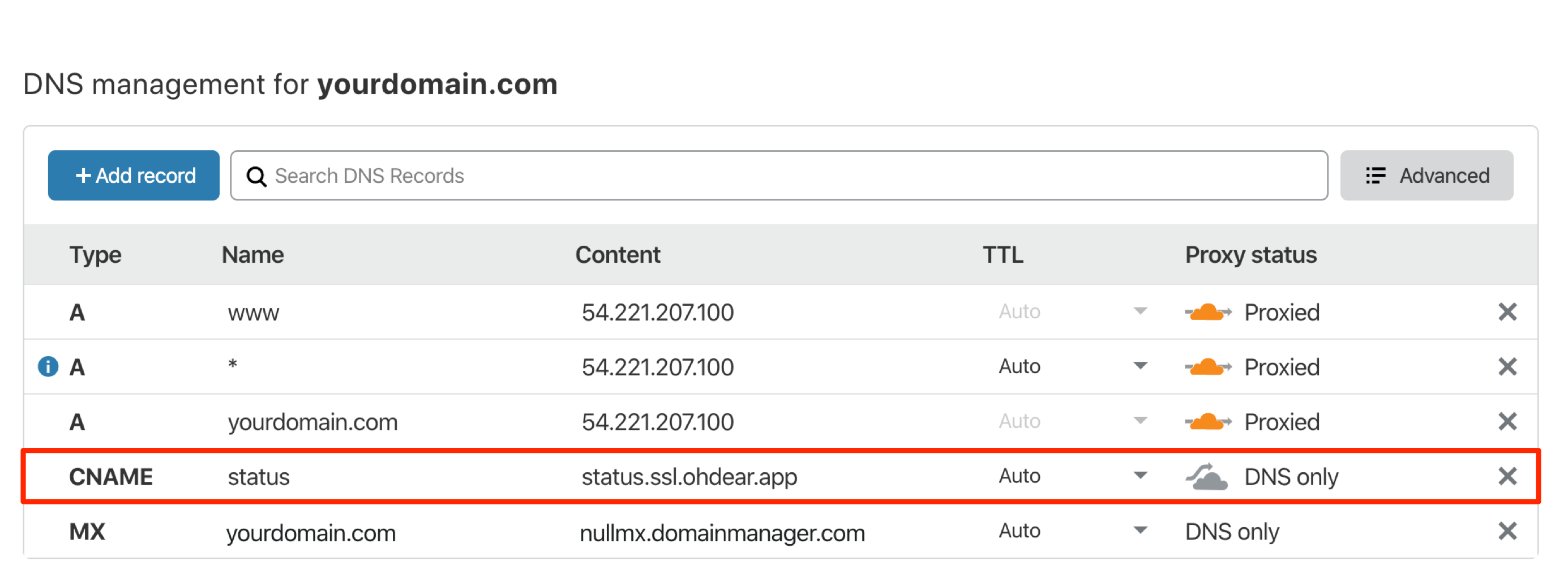
Proxied (the orange cloud). Want Cloudflare's CDN and DDoS protection in front of your status page? Enable the proxy. For Full SSL/TLS mode, that's all you need to do.
Prefer Full (strict)? That works too. Head to the Certificate tab in your status page settings and verify you own the domain first. From there you can either download the origin certificate we generate and tell Cloudflare to trust it, or upload your own certificate and private key. Either way, your origin presents a certificate Cloudflare is happy with.
For the full walkthrough, and how to fix a Cloudflare "Error 526", see How do I put Cloudflare in front of my status page?.
Feel free to reach out via support@ohdear.app or on X via @OhDearApp if you have any other questions. We'd love to help!