Why should I monitor for downtime?
Whether you're running a personal blog, a corporate site, an online store, or a small empire of client sites, downtime costs you something. Money, reputation, SEO rankings, sleep, or all of the above. You can't always prevent it, but you can always know about it quickly, and that alone makes a huge difference in how much damage an outage actually does.
The "just check it manually" approach #
You can quickly check if your site is up right now without any tooling, but don't just hit refresh in the browser you always use. It might return a cached page and show you a working site that's actually down for everyone else.
Better ways to do a quick manual check:
- Visit the site from a different device
- Load it over a different network (mobile data, VPN, a friend's Wi-Fi)
- Use a public "is it down?" checker like isitdownrightnow.com
- Ask someone in another city to try it
Why manual checks aren't enough #
These work for a one-off question, but they're reactive by definition. They can't answer:
- How long has the site been down?
- Is this a recurring issue?
- What exactly failed: DNS, the server, the application?
- Will I know immediately the next time it happens?
That's what monitoring is for.
Common causes of website downtime #
Before we get to monitoring itself, it helps to know what typically goes wrong:
- Server issues: any website lives on a server, and servers have hardware and software failures like any other computer.
- Domain and DNS problems: an expired domain, misconfigured DNS records, or a flaky DNS provider can take you offline even when your servers are perfectly fine.
- Network and connectivity issues: problems on your hosting provider's network, a saturated uplink, or a server buckling under traffic can all cause outages.
- Application errors: not technically "downtime", but application errors can break critical features while the site appears to be up. Third-party plugins and integrations are a frequent culprit.
What you can control #
Plenty of downtime causes are partly or fully under your control:
- Right-size your hosting. Pick a plan that fits your real load, and be ready to scale during spikes.
- Set up auto-renewal on your domains. And keep payment details current. An expired domain is a completely preventable outage.
- Ship carefully. Run tests, use staging, and roll out gradually. Most application-level outages come from deploys, not hardware failures.
- Plan maintenance. Schedule it during low-traffic windows, and announce it on your status page.
- Invest in basic security. Intrusion detection, bot protection, and monitoring go a long way.
- Have a rollback plan. When something breaks in production, the fastest recovery is usually "go back to the last known-good version".
Doing all of this doesn't prevent every outage, but it dramatically lowers how often and how long they happen.
Why automated monitoring is worth it #
You won't manually check your uptime, and even if you tried, you'd rarely catch the exact moment something breaks. That's the whole reason monitoring tools exist.
With continuous monitoring you get:
- Instant alerts the moment a check fails (and recovers)
- Historical data to spot patterns (Friday afternoons, sales events, specific regions)
- Richer checks than just "is it up?", including certificates, DNS, broken links, Lighthouse scores, cron jobs, and more
Historical data matters more than people realize. If you can show that your site slows down during a weekly sync job, or goes wobbly every Black Friday, you can actually fix the underlying cause instead of guessing.
What Oh Dear does for your uptime #
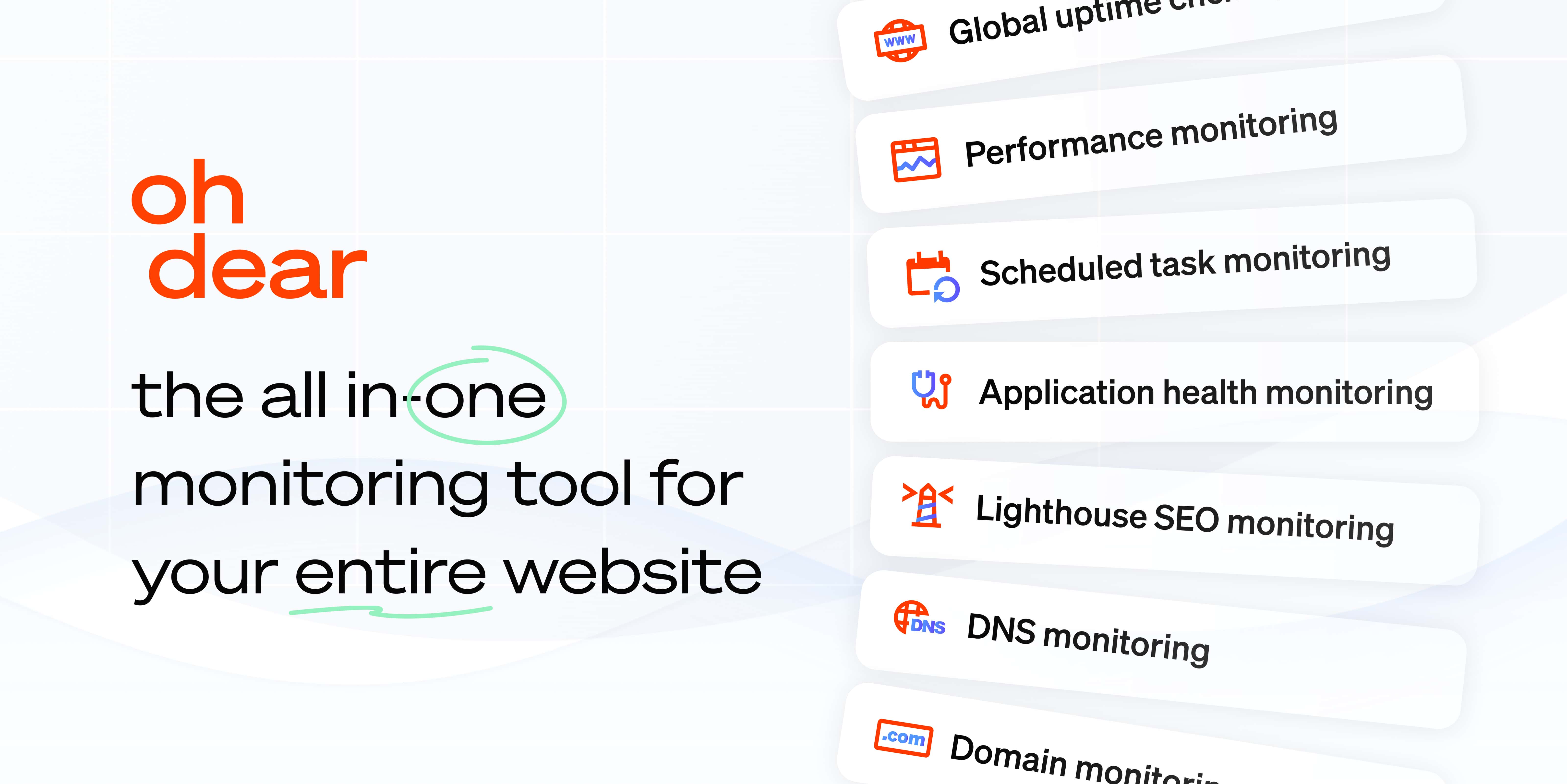
This is where we admit the obvious self-promotion. Oh Dear is a full-stack monitoring tool built for developers and agencies who want one platform instead of five:
- Proactive alerts, not just "your site is down". We warn you before domains expire, before certificates expire, when Lighthouse scores drop, and when DNS records change.
- Notifications where you already are: email, Slack, Microsoft Teams, Discord, Telegram, SMS, Pushover, Opsgenie, PagerDuty, webhooks, and more.
- Public status pages so customers know what's going on during an incident.
- Lighthouse SEO monitoring to keep an eye on Core Web Vitals and SEO signals over time.
- Broken links, mixed content, and sitemap monitoring on the side.
Try Oh Dear free for 10 days. No credit card required, and you'll be monitoring within a minute.