Website maintenance costs, and how to keep them down
Published on November 16, 2026 by Mattias Geniar

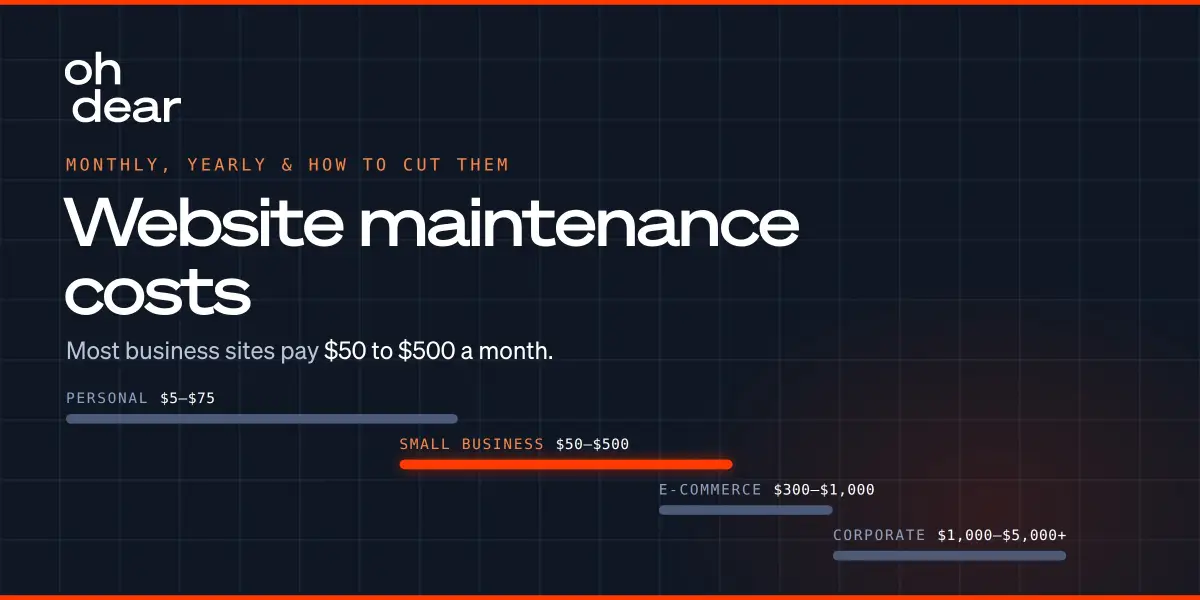
How much does it cost to keep a website running? For most small and medium business sites, between $50 and $500 a month. That's GoDaddy's estimate for website maintenance costs. A personal blog can get by on about $5 a month. A large corporate or custom site costs $5,000 or more a month.
That range is wide because maintenance means different things on different sites. A simple five-page site needs less than a shop that takes payments. And a site you run yourself costs less money, but more of your own time.
Prices are in US dollars unless stated otherwise. UK prices are lower for the same work. So read the figures below as US prices, and expect to pay less in the UK.
What website maintenance actually includes #
Website maintenance is the ongoing work that keeps a site online, secure, fast, and working as intended. It falls into six groups.
- Hosting and domain: Hosting stores your site files and sends them to visitors. Your domain name is the address. You have to renew it every year, or the site goes offline. Domain monitoring warns you before the registration expires. DNS monitoring tells you when a record changes. Shared hosting starts at a few dollars a month. Dedicated servers cost $80 to $500+ a month.
- Updates: The site platform, themes, plugins, and any custom code. On a WordPress site, that means keeping WordPress, its plugins, and the theme up to date. Then a known bug or security problem doesn't stay on your site for months. Security releases can take sites offline too. In October, two critical security problems in PHP were made public. Many site owners took their sites offline until the fix was out. At the peak, 18.8% of the sites we monitor were down.
- Backups: Dated copies of your files and database. If an update breaks something or a file gets deleted, a backup lets you restore the site instead of rebuilding it. GoDaddy lists automated backups at $0 to $20 or more a month. Elementor includes backups in every maintenance plan it prices. If your backups run as a scheduled task (a cron job), scheduled task monitoring tells you when a run is missed. You find out long before you need the backup.
- Security: SSL certificates, malware scanning, firewall rules, patching, ... A free SSL certificate costs nothing. A standard paid certificate costs about $10 to $100 a year. Advanced certificates cost $100 to $300 or more.
- Monitoring: This watches the site when you're not looking. Uptime checks confirm the site answers. Broken-link crawls list dead links. Certificate checks warn you before an SSL certificate expires. New to this? Here's how website monitoring works. GoDaddy lists uptime monitoring at $0 to $30 or more a month.
- Content and support: Content updates cover new pages, product changes, images, and fixes to text. Support is the time a person spends on everything else: answering questions, fixing what breaks, making small changes. GoDaddy puts blog or page updates at $0 to $500 or more per piece. It puts content refreshes at $100 to $1,000 or more.
What website maintenance costs per month and per year #
The cost of maintaining a website per month is $50 to $500 for most business sites, according to GoDaddy's guide. That's $600 to $6,000 a year. Compare any quote you get with that website maintenance cost per month. Elementor, WebFX, and Rocket.net publish different ranges for the same site types. The table below shows where the guides agree and where they don't. These are published estimates, not a quote. Ask any provider to split their quote into the same items, so you can compare.
| Site type | Monthly range in published guides | Yearly range |
|---|---|---|
| Personal website or blog | $5-$75 (GoDaddy, Elementor); $5-$25 (WebFX); $100-$200 (Rocket.net) | $60-$900 |
| Small business website | $35-$500 (Elementor); $50-$500 (GoDaddy); $35-$100 (WebFX); $500-$1,000 (Rocket.net) | $600-$6,000 for the GoDaddy range |
| Corporate website | $200-$4,500 (Elementor); $200-$3,500 (WebFX); $1,000-$5,000+ (GoDaddy); $1,000-$4,500 (Rocket.net) | $12,000-$60,000+ at the GoDaddy corporate range |
| E-commerce store | $300-$1,000 (GoDaddy); $750-$5,000+ (Elementor, Rocket.net); $1,500-$2,500 (WebFX) | $3,600-$12,000 at the GoDaddy e-commerce range; $4,323-$22,608+ in Elementor's worked example |
| Web application or custom site | $300-$2,500 (WebFX web application); $2,000-$25,000+ (GoDaddy enterprise) | $24,000-$300,000+ at the GoDaddy enterprise range |
Personal and small business sites don't cost much money to maintain. Elementor's worked example for a small business site adds up domain, hosting, SSL, basic maintenance, and the occasional content update. The total is $36.25 to $267.50 a month, or $435 to $3,210 a year. Want to pay even less? Build the site with Astro and an AI tool of your choice. Then publish it from GitHub to a static site host like Sevalla or GitHub Pages. That's often free.
E-commerce and corporate sites cost more because there's more to maintain: PCI compliance (the security rules for taking card payments), product and inventory tools, connections to shipping and tax services, more complex support, ... GoDaddy prices those extras separately. They go from $10 a month for security and PCI work to $200 a month for customer experience tools.
From the research I've done, prices differ a lot. They also differ a lot between regions around the world. At the high end, Rocket.net puts small business maintenance at $500 to $1,000 a month. At the low end, WebFX puts a small business website at $35 to $100 a month. It puts a small-to-medium business website at $125 to $500 a month. The difference is usually what's included. One guide prices the hours an agency works on your site. The other prices the tools and hosting. So when you compare quotes, compare the task list, not just the monthly number. And yes, you could do it all yourself with an AI tool. But there's always a risk that you put a broken site online.
A useful middle figure: WebFX reports website maintenance costs of $3,600 to $50,000 in its survey data. Small businesses typically pay $3,600 to $12,000. Be warned though: the page doesn't say what period those survey figures cover. Its chart label says per month. So I'd read them as WebFX's survey wording, not a precise yearly rate. Separately, WebFX gives a yearly average of $300 to $60,000. That one is clearly labelled as yearly.
How much it costs to maintain a website yourself vs paying someone #
Doing it yourself costs the least money and the most time. Paying someone costs more money and saves you that time.
- Doing it yourself: You pay for hosting (which can be free nowadays), domain renewal, SSL, backups, and monitoring tools. GoDaddy prices shared hosting at $5 to $15 a month. SSL is free. Automated backups are $0 to $20 or more a month. Uptime monitoring is $0 to $30 or more a month. Add a domain renewal of roughly $10 to $130 a year. The rest is your time: updates, backup checks, security scans, fixing what breaks, watching for downtime, ... If an update breaks the site at 11 p.m., you're the one who has to fix it. So make sure alerts reach you somewhere you'll see them.
- Hiring a freelancer: Usually the middle option. Upwork lists developer hourly rates at $15 to $50 or more an hour. A monthly retainer costs several hundred dollars. A retainer is mostly that hourly rate, sold as a monthly package. Hours you don't use don't always move to the next month.
- Hiring an agency: Agencies charge the most and do the most tasks. WebFX's own plans start at $350 a month for WordPress sites of 500 pages or fewer. They start at $550 a month for enterprise WordPress or WooCommerce sites. The plans include daily security scans, backups, quarterly upgrades, and weekday support. Rocket.net's plans go from basic maintenance at $500 to $1,000 a month to premium at $2,500 to $5,000 a month.
If your site is small and you have the skills, do the routine tasks yourself. Pay for monitoring, so you hear about problems fast. If updates or security fixes regularly take a day a month, a small retainer from a freelancer or agency is usually cheaper than the hours you lose. If the site takes payments or handles customer data, pay for the security and compliance work.
How companies reduce website maintenance costs #
Companies that keep maintenance bills down don't skip maintenance. They remove what causes emergency fixes. That's where the money goes. These are the six tactics I recommend to anyone.
- Automate updates and monitoring: Manual checks cost hours every week and still miss things. Automated updates, backups, and uptime monitoring replace those hours with a fixed monthly fee for a tool. At Oh Dear, monitoring starts at $17 a month for two sites. We check your site every minute. We confirm every failure from a second location. We look for broken links every day. We check SSL certificates every 30 minutes. So you hear about a problem from an alert, not from a customer complaint or an emergency invoice.
- Catch downtime and broken links early: Emergency support is the most expensive item in the guides. Rocket.net prices it at $200 to $350 an hour, which is more than standard support. A site that's down for a weekend costs you lost orders, plus the bill for emergency help. Our uptime statistics from 1.8 million real outages show that most downtime is over in minutes. The few long outages do the damage. Early alerts make those shorter.
- Use fewer tools: A small business site often pays for separate tools for backups, security scans, uptime checks, and reports. Elementor's cost breakdown lists backups and security work as separate items. Each one has a monthly fee or a renewal date you have to keep track of. Oh Dear covers monitoring, certificates, broken links, and monthly client reports in one place. That replaces several subscriptions and several logins.
- Choose stable software and avoid too many plugins: Every plugin or extension is one more thing to update. It's also one more thing that can break another part of the site. WebFX prices plugin costs at $0 to $50 a month. It notes that the cost depends on how many plugins you use. Check your plugins once a year and remove what you don't use. Less to maintain, less to go wrong.
- Schedule preventive maintenance: GoDaddy's guide and HubSpot's checklist both say planned reviews are cheaper than repairs after something breaks. Review your content at least once a year. Check your plugins once a year. Test that your backups work. I've also written up 10 ways to prevent website downtime. A planned hour a month is better than a weekend of repair work. It also keeps your costs in the ranges from the table above, and out of custom-development prices.
- Review plans yearly: Maintenance plans and hosting renewals slowly get more expensive. Once a year, compare your plan with what you used. Switch plans if yours has become too small, or if you pay for things you never needed. Before you sign, ask your provider what happens at renewal. Get the answer in writing.
None of this makes the site itself cheaper. You get fewer surprises. Less emergency work means a lower bill.
Website maintenance plans: what to look for #
A maintenance plan is only worth the monthly fee if you can see what it covers. Use this checklist when you compare providers. Compare the monitoring part of a plan with the public prices of monitoring tools. Then you know what monitoring alone should cost.
Inclusions to expect in writing:
- Updates for the platform, theme, and plugins, with a named schedule
- Automated backups, with the retention period and the restore process stated
- Uptime monitoring and broken-link checks, with alert delivery by email or chat
- SSL certificate monitoring and renewal handling
- Security scans and malware removal, stated as included or as a paid extra
- Content updates, with a clear limit per month
- Support response time, stated in hours, including what counts as an emergency
- Monthly reporting that lists work done and problems found
Red flags:
- A plan that lists no backup frequency or no restore process
- Monitoring mentioned, but no alert method or response time
- Content updates billed per change with no monthly cap
- No written list of what's excluded, so every fix becomes a negotiation
- Renewal price not stated, or support hours limited to business hours with no emergency route
Questions to ask any provider:
- What tasks are included each month, and what costs extra?
- How often are backups taken, and when did you last test a restore?
- How fast will you tell me if the site goes down, and how?
- What happens to my site and data if I cancel?
- What does the plan cost at renewal, and what changed since last year?
If a provider can't answer those five questions in plain sentences, the plan will probably cost more than its listed price.
If you're not an Oh Dear customer yet, you can try it for 10 days, free, no credit card needed.
Frequently asked questions #
How much does website maintenance cost per month?
Most personal, blog, and small business sites cost $5 to $500 a month to maintain. Corporate, e-commerce, and custom sites can go up to $1,000 to $5,000 or more a month. What the plan includes changes the monthly price more than the size of the site does.
How much does it cost to maintain a website per year?
At GoDaddy's published ranges, website maintenance costs $600 to $6,000 a year for a small to medium business site. An e-commerce store costs $3,600 to $12,000 a year. Large corporate or custom sites cost $12,000 to $60,000 or more a year. WebFX reports a wider survey range of $3,600 to $50,000, with small businesses typically at $3,600 to $12,000. But its page doesn't say what period those figures cover.
What does website maintenance include?
Hosting and domain renewal, platform and plugin updates, automated backups, security work such as SSL certificates and malware scanning, uptime and broken-link monitoring, content updates, and support. GoDaddy prices each part separately. For example, automated backups are $0 to $20 or more a month, and developer time is $15 to $50 or more an hour.
How much should I pay someone to manage my website?
A freelancer costs $100 to $500 or more a month on a retainer. For one-off work, a freelancer costs $15 to $50 or more an hour. Agency plans start around $350 a month for a standard WordPress site at WebFX. At Rocket.net, basic care plans start at $500 a month.
How much should a website cost to develop?
According to Rocket.net's figures, website development costs $3,000 to $5,000 in the first year for a small business site. An enterprise site costs $10,000 to $60,000. Development is a one-time build cost. Maintenance is the ongoing monthly or yearly cost of keeping that site working.